
A Nearly 100-Million-Year-Old Hairy Snail Pays Tribute to The Prodigy’s Lead Singer
A Nearly 100-Million-Year-Old Hairy Snail Pays Tribute to The Prodigy’s Lead Singer
Burmese amber (more commonly known as “burmite”) is one of the most important sources of information about biodiversity during the Mesozoic Era. This amber dates back to the age of the dinosaurs and is approximately 99 million years old. Burmite preserves numerous now-extinct organisms (animals, plants, fungi, etc.) as inclusions, often in astonishing detail. This is because amber can preserve even soft tissues, which would otherwise decompose rapidly, and do so in three dimensions.
Thanks to a collaboration between researchers from the HUN-REN Centre for Agricultural Research, Széchenyi István University, Eötvös Loránd University, the Hungarian Natural History Museum, the University of Szeged, and the Chinese Academy of Sciences, a bizarre-looking terrestrial snail has been added to the list of ancient animal species known from burmite. The scientific paper resulting from this research has been published in the journal Ecologica Montenegrina:
The shell of the new snail species is low-spired and circular when viewed from above, and is covered with hair-like appendages. These appendages are part of the shell’s outer, protein-based layer, known as the periostracum. The piece of amber containing the snail was scanned using micro-CT at the Department of Applied and Environmental Chemistry of the University of Szeged, Hungary. This enabled the researchers to obtain as much information as possible about the snail by creating a digital model of the specimen.
The new species has been named Archaeospirostoma flinti, in honour of Keith Flint, the lead singer of the British band The Prodigy, who died in 2019. The hairs covering the shell of the new snail reminded the authors of Flint’s distinctive hairstyle. The new species belongs to the snail family Cyclophoridae.
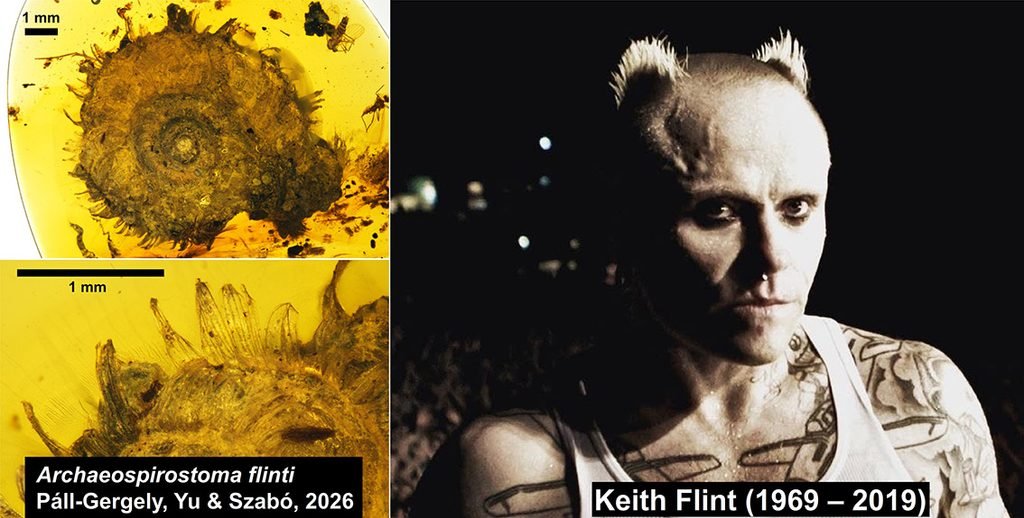
The holotype of Archaeospirostoma flinti and Keith Flint (1969–2019), former lead singer of The Prodigy, sporting his iconic hairstyle. Sources: Páll-Gergely et al., 2026, and facebook.com/theprodigyofficial
“Research on snails preserved in Burmese amber has experienced a renaissance in recent years, partly thanks to the increasingly widespread use of micro-CT scanning in scientific research. This technique allows us to scan and examine an otherwise extremely fragile and tiny amber inclusion as a three-dimensional model without putting it at any risk whatsoever. The work of our colleagues at the micro-CT laboratory of the University of Szeged was therefore instrumental in enabling us to describe the new snail species in detail,” said Márton Szabó, a researcher at the Department of Palaeontology of Eötvös Loránd University and the Hungarian Natural History Museum.
The new species is the ninth member of the snail family Cyclophoridae to have been discovered in Burmese amber. Seven of these species have “hairs”, while the shell surfaces of the other two are smooth. Archaeospirostoma flinti differs from the other “hairy” snails discovered in burmite in the arrangement of its shell hairs. Whereas the hairs of the previously known species consist of individual, longer or shorter projections, those of the new species are grouped into flat “fringes”, each composed of several elements of equal length.
“It is particularly exciting that the aperture of the best-preserved specimens of the new species retains the so-called operculum, or shell lid. Essentially, this is a door that the snail used to close the aperture of its shell. Its shape is entirely unique among the members of this family known from Burmese amber: it is conical in side view” explained Dr Barna Páll-Gergely of the HUN-REN Centre for Agricultural Research and Széchenyi István University, who led the study.
“The function of this conical operculum is not yet entirely clear, although there are living aquatic snail species known to use their cone-shaped opercula somewhat like a diving piston, forcing oxygen-rich respiratory water through their respiratory organs. Naturally, this is not what we are suggesting in this case, given that the newly described snail species was terrestrial.”
Palaeontological research on snail species preserved in Burmese amber is continuing, with the aim of building an increasingly detailed picture of the evolution of terrestrial snail anatomy and the biodiversity of our planet nearly 100 million years ago.